
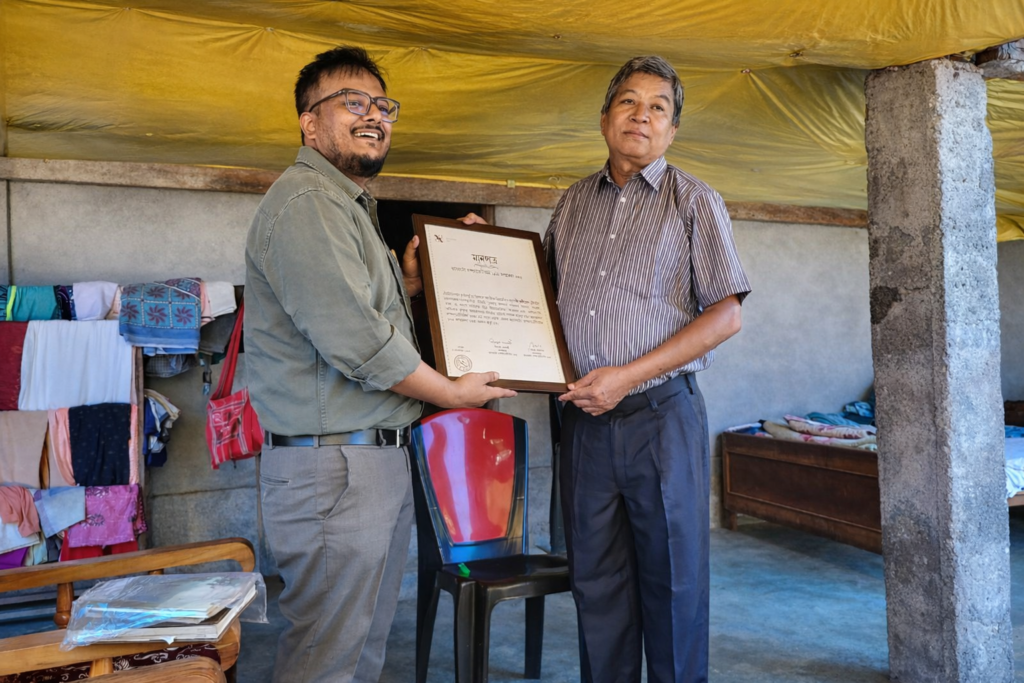
The inaugural CC1919 Award was conferred upon Dhaniram Toto for his decades-long commitment to the Toto language, a tongue spoken by fewer than two thousand people in the northern Bengal. Being faced with the imminent erasure of his community’s linguistic heritage, Dhaniram Toto created a script and constructed an alphabet for a language that had existed only in speech.
The CC1919 working committee team travelled to Totopara in Alipurduar district, West Bengal to personally deliver the award, recognising his work a profound act of cultural defiance, where dominant narratives predicted the inevitable disappearance of minority languages and he chose preservation through the creation of a living instrument of cultural continuity.

The second CC1919 Award was conferred upon Manjira Saha during the 6th Establishment Event for her unflinching literary literary examination of borderland existence. Through Chotoder Border (Border of the Little Ones), Meyeder Border (Border of the Women), and Borderer Prem (Love at the Border), Saha has constructed a trilogy that chronicles children, women, and communities for whom borders are not abstractions but daily realities.
The CC1919 Awards Committee recognised Saha’s contribution as fundamentally altering the landscape of border narratives in contemporary Bengali literature. She writes displacement not as metaphor but as material condition, insisting that borders reveal more about those who draw them than those who must cross them.